
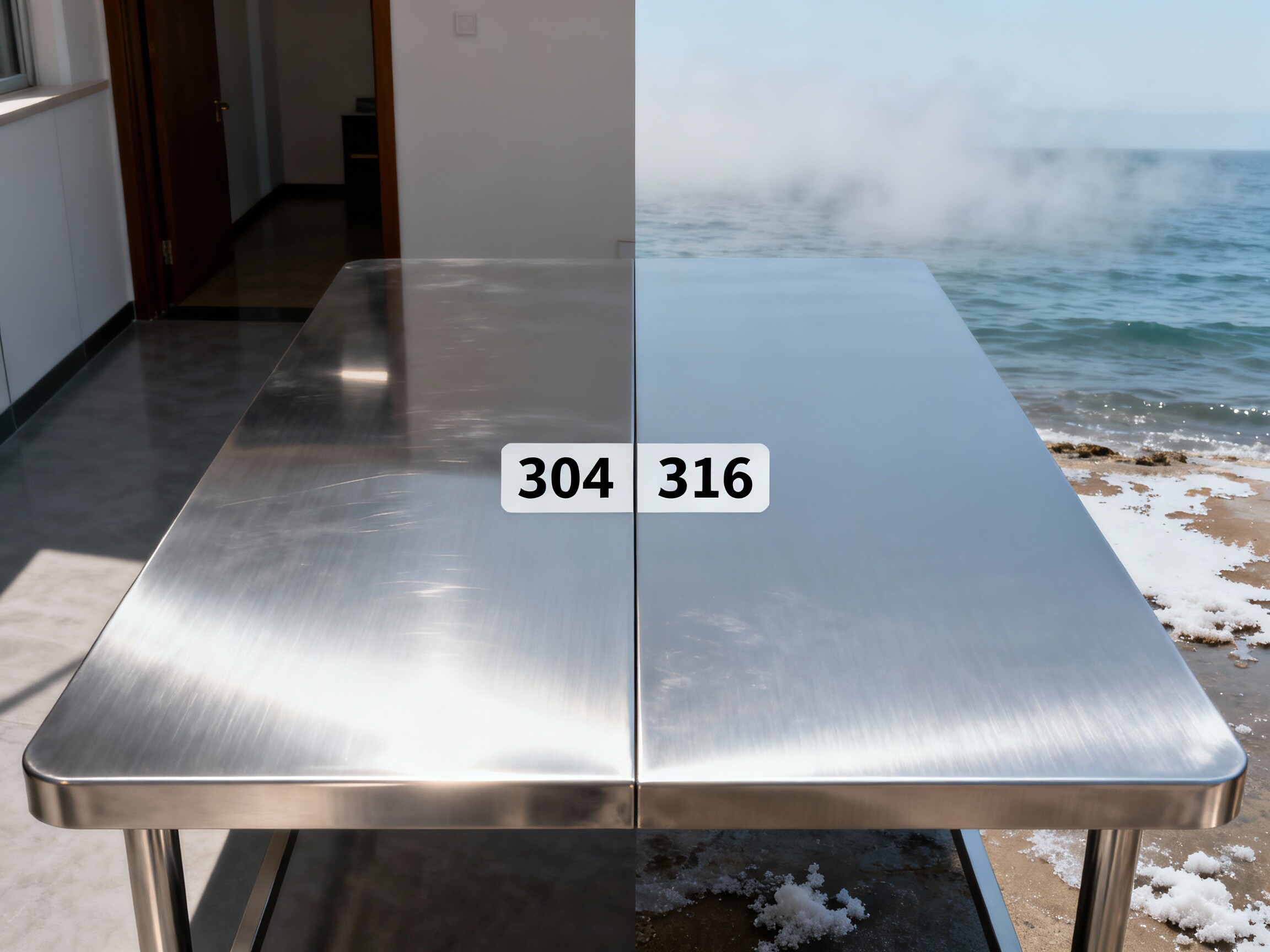
304 and 316 are two of the most commonly used austenitic stainless steels, with the core difference being their corrosion resistance:
304 stainless steel: Contains 18% chromium and 8% nickel (18/8 stainless steel). It has good corrosion resistance and workability, and can resist most organic acids and atmospheric oxidation. It is a general-purpose stainless steel, suitable for most conventional environments such as kitchenware, home furnishings, building interiors, and food processing equipment.
316 stainless steel: Based on 304, it adds approximately 2-3% molybdenum (Mo). This element significantly enhances its resistance to chloride corrosion. Key applications: coastal building facades (resistant to sea breeze and salt spray), chemical equipment, marine fittings, medical devices, and industrial equipment used for processing solutions containing chloride ions.
Ruisibo recommends: If your product will be used in coastal areas or environments exposed to chemicals, seawater, or salt, it is strongly recommended to choose 316 stainless steel to ensure long-term safety and aesthetics. For conventional inland environments, the more cost-effective 304 stainless steel is an ideal choice.
Related Posts
Contact Us
Leave a Message
Thank you for your interest in our products. "*" Indicates the Fields are Mandatory